Works today in ChatGPT desktop & Chrome 149
The website builder built for humans and agents.
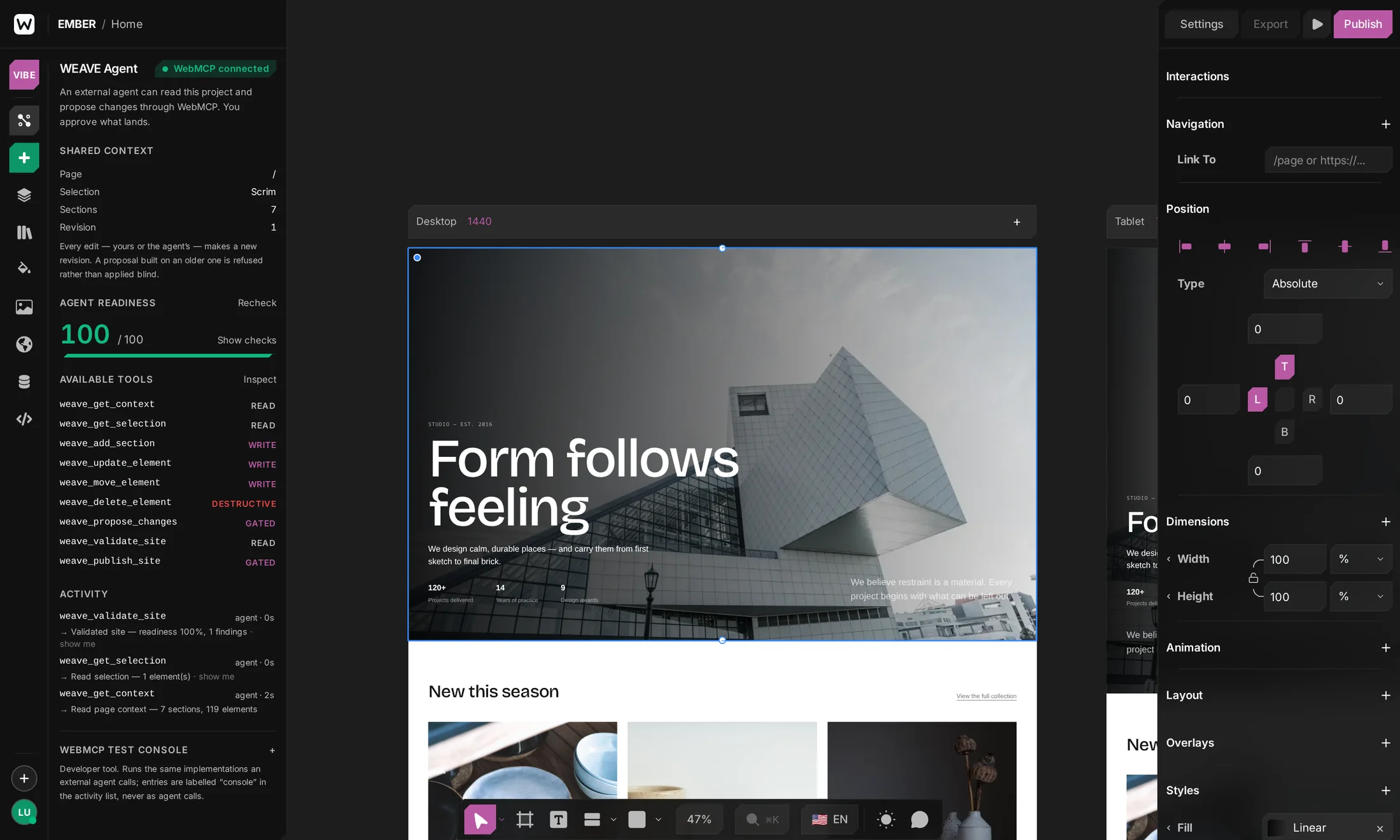
Build visually. Direct your agent. Publish an agent-ready website. A real visual editor where a person and an AI agent author the same live project through WebMCP — structured context, reviewable proposals, and a human approval gate before anything ships.
Live demo storefront in your browser. Nothing to install, no account.
How it works
One project. Two authors.
The agent never guesses from pixels and never edits behind your back. It reads the same structured model the canvas renders from, and proposes work you approve.
Human
Edit on a real canvas
Drag, type, restyle. Every edit becomes a new project revision.
Agent
Read structured context
Typed sections, stable element ids, your selection — not a DOM dump.
Agent
Propose a change set
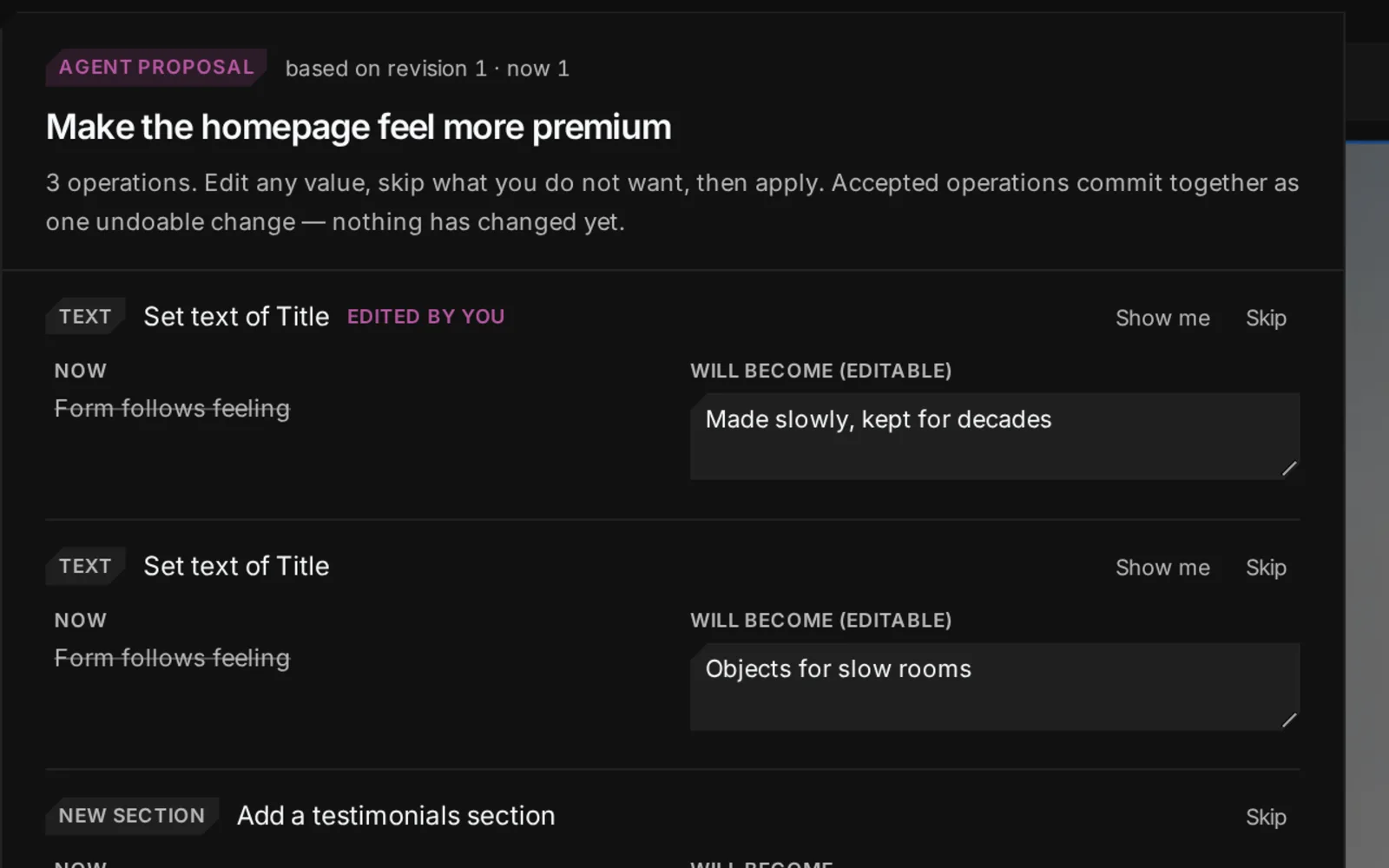
Related edits arrive as one reviewable proposal. The canvas doesn’t move.
Human
Amend, skip, apply
Rewrite a value, drop an operation, apply the rest. One undo reverses it all.
WEAVE
Gate the publish
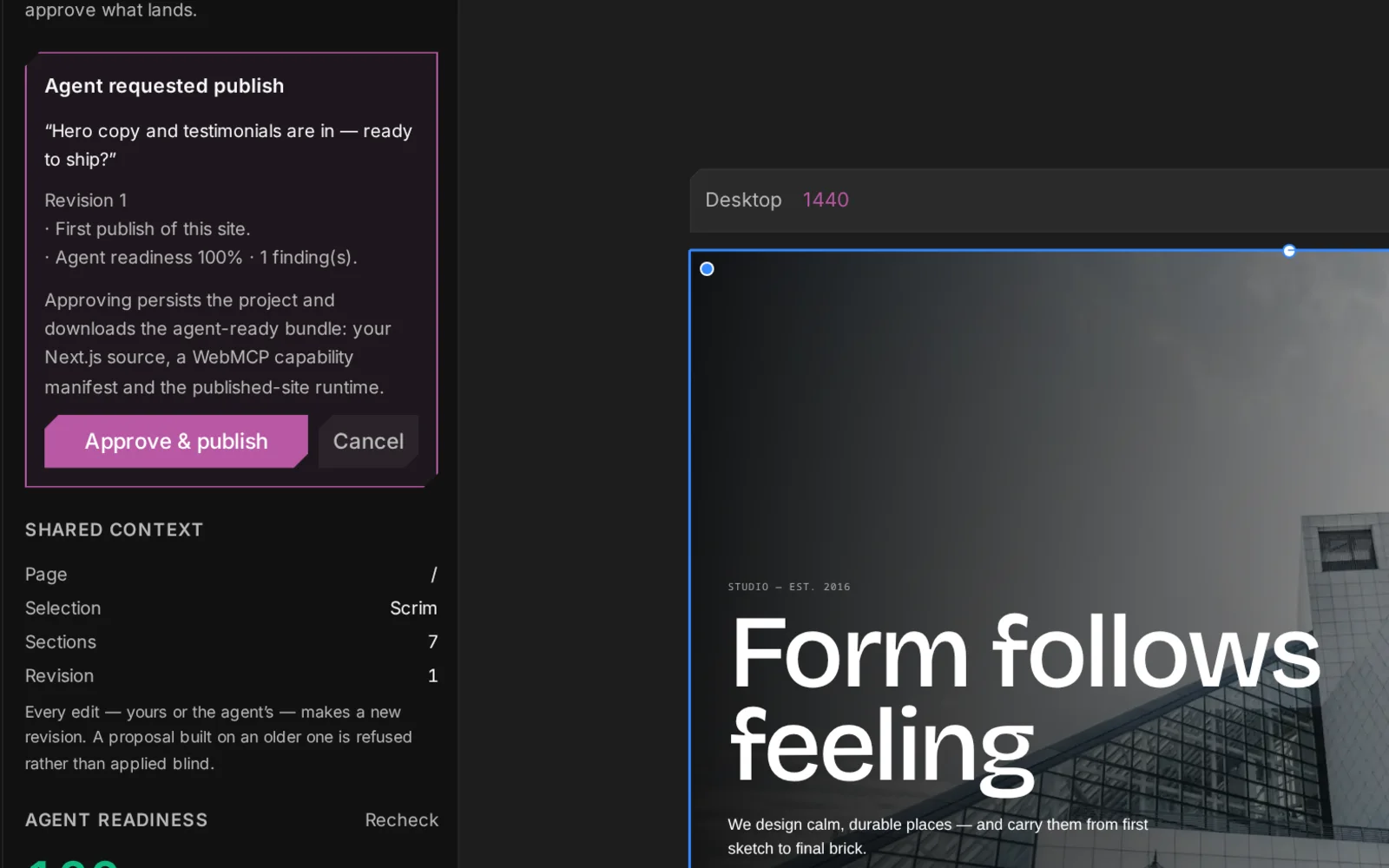
An agent can request a publish. Only your click performs one.
Change sets
Transactions, not one-off edits.
“Make this homepage feel more premium” becomes one proposal containing several operations — not five edits fired at your canvas one at a time.
- See every operation’s before and after
- Rewrite any value the agent chose
- Skip the parts you don’t want
- Accepted work commits atomically as one revision
- A single undo reverses the whole transaction
Safety
The agent can ask. Only you can ship.
There is no code path from a tool call to a deploy. A publish request opens an approval card showing the revision and exactly what changed since the last one.
- Destructive tools are annotated as destructive
- Proposals pinned to a revision — stale ones are refused
- Three validation layers before anything touches your project
- No
eval, no arbitrary code, nojavascript:URLs
Inspectable
Every claim is checkable, live.
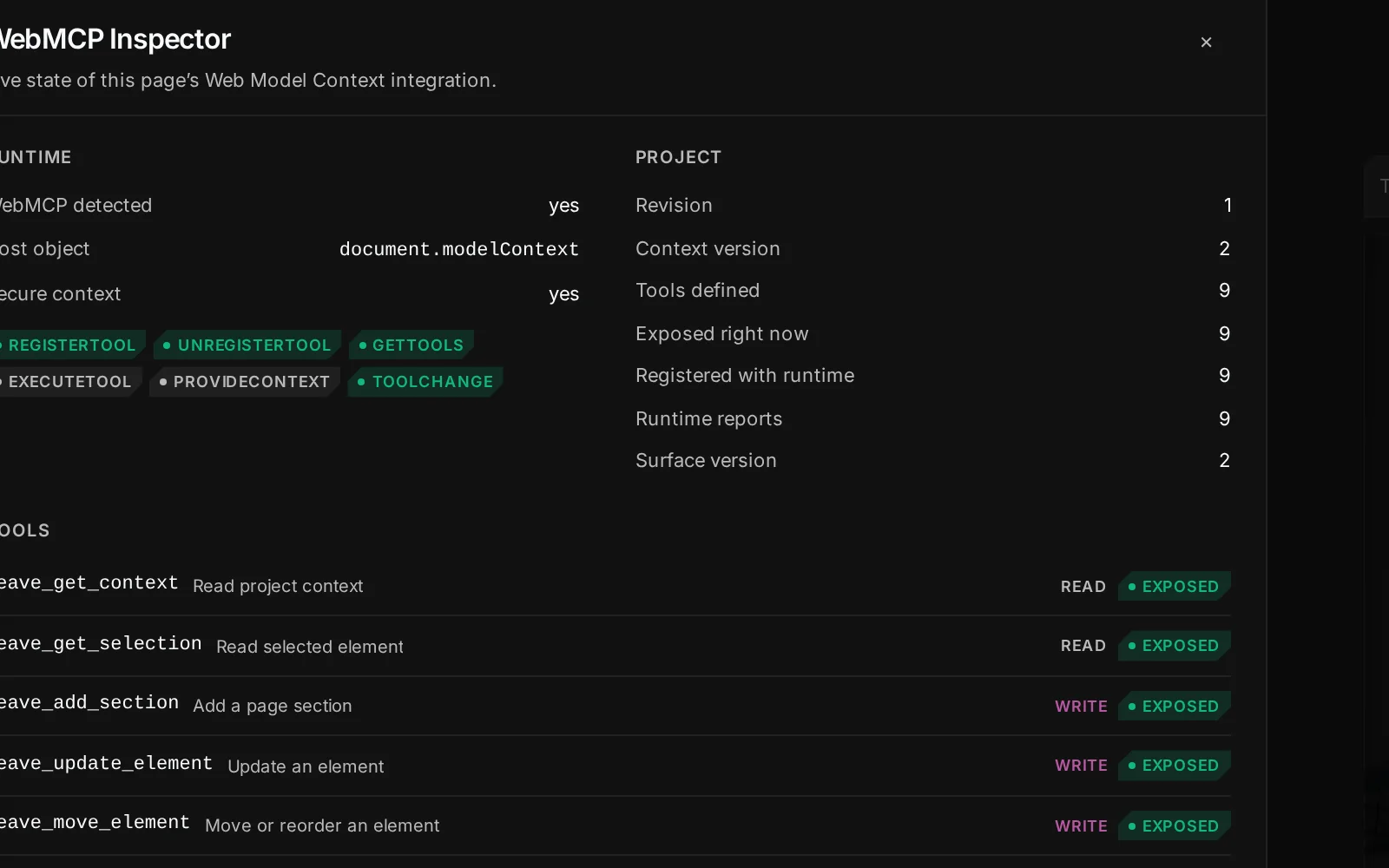
The Inspector reports what is actually registered right now — read from the runtime, not from our documentation.
- Which global carries the runtime, and which API members exist
- Every tool’s JSON schema and annotations
- Which tools are exposed vs hidden, and why
- The last invocation each tool received
Efficiency
Structure costs less than pixels.
Measured on this build’s demo page. An agent reading structured context instead of the raw DOM spends roughly a tenth of the tokens — and every id it gets back is directly actionable, so there is no second “find the element” step.
The surface
Nine typed tools.
Registered with the browser’s model-context runtime. Descriptions state product intent; annotations declare real consequences. Element tools appear only while you have something selected.
| Tool | Access | What it does |
|---|---|---|
| weave_get_context | read | Page, revision, selection, typed sections, bounded element tree |
| weave_get_selection | read | Full detail for the element you have selected |
| weave_add_section | write | Insert a designed section from the shared library |
| weave_update_element | write | Text, name, visibility, safe styles and attributes |
| weave_move_element | write | Reorder or re-parent a section or element |
| weave_delete_element | destructive | Remove an element and its children |
| weave_propose_changes | human review | Submit several edits as one reviewable proposal |
| weave_validate_site | read | Real findings plus an explainable agent-readiness score |
| weave_publish_site | human approval | Request a publish — only your click performs one |
Where this actually stands
- WebMCP is an emerging standard. If your browser exposes no runtime, the editor says so plainly — the tools stay usable through the built-in developer console, which calls the identical implementations.
- Agent context is pull-based: WEAVE bumps a revision on every change and agents re-read. It does not pretend to push page content the shipping API cannot push.
- “Publish” means persist and download a complete, agent-ready bundle. No third-party deployment provider is contacted or simulated.
- The runtime shipped with a published site is read-only plus same-site navigation, by design.
Open it and give your agent something to read.
A live storefront, nine tools, and an approval gate. No install, no account.